
The Land of Nod is where you’d love to be!
‘The Land of Nod’ beckons, and you’re floating on a magic carpet, when suddenly, Trrrr-ing, trrr-ing- the harsh, jarring notes of your alarm clock bring you rudely back to earth. It’s time to rise and shine and throw off that cloak of sleep that still envelops you. You barely manage to get going as you are still groggy with sleep, and robotically, you start another day.
Caught Napping?
Catching 40 winks, grabbing some quick ZZs, nodding over your class assignment, having a catnap? Don’t feel guilty. You’re not alone; it happens to most of us more often than we care to admit. And if you are cranky and irritable because you haven’t slept well, you have good cause to be. Folks, I’m on your side, for I believe that there is nothing more refreshing than a good night’s sleep. We don’t realize this until we are actually sleep-deficient.
What the doctor ordered
An Irish Proverb says that “A good laugh and a long sleep are the best cures in a doctor’s book”. What could be truer than that? It’s a given that “laughter is the best medicine and sleep the world’s greatest healer”. The fact that we spend about a third of our lives in ‘The land of Nod’ suggests how significant sleep is. If you think that you need only food and water to survive, think again. Without sleep, you’ll become a wreck in no time at all.
When the natural sleep-wake cycle and the natural circadian rhythm (more of this later) are thrown out of gear, life becomes miserable. The effects of sleep deprivation are catastrophic- it strips you of the ability to focus, to think clearly, to solve problems, or to make decisions. It totally incapacitates and you become a living wreck. That’s what happens when we suffer from jet lag. And that’s why a good, refreshing sleep acts as a natural ‘restorative’.
Land of Nod – Is sleep a state of dormancy?
You’d think that our bodies would go into shut-down mode when we enter the Land of Nod, but that’s not how it is.
Dr. Maiken Nedergaard, who studies sleep at the University of Rochester, says that “While you sleep, your brain is working. For example, sleep helps prepare your brain to learn, remember, and create.”
So, even if you’re asleep, your brain remains active. It uses ‘sleep time’ to actively ‘process and consolidate information’ by transferring memories from the short-term compartment in the hippocampus to the long-term reservoirs in the cortex. This explains why you’re able to recollect information (crammed during waking hours the previous night) on the morning of an exam.
And not just that, the body’s laboratories are actively synthesizing hormones (chemicals produced by the body), repairing tissues, helping muscle growth, and improving other skills.
Hormones are Important
Speaking of hormones, many of them are intimately connected with sleep. So much so that lack of sleep invariably creates a hormonal imbalance, and if there is a hormonal imbalance for any other reason, it’s bound to affect your sleep.
Most of the hormones are produced by the pituitary gland, but the sleep hormone, Melatonin, is an exception. It’s produced in the pineal gland. Its production decreases in light and increases when it’s dark. It steadily builds up in the body during the day, making it easier for you to sleep at night. The glass of warm milk, usually prescribed at bedtime, contains Tryptophan, which stimulates the production of Serotonin that is converted to melatonin. So, make drinking milk a habit!
Do you know why electronic devices are banned at bedtime? The blue light that emanates from your phone or Kindle disrupts and delays the production of melatonin, which in turn delays the onset of sleep. So, do put those away well before your bedtime.
While melatonin prepares your body to go into sleep mode, another hormone, cortisol, acts as a wake-up call.
A word here about neurotransmitters (those chemical brain messengers) is not out of place. Many of them function while you’re asleep and contribute to overall brain health and memory consolidation. Neurotransmitters like serotonin, norepinephrine, Acetylcholine, and adenosine are dominant during a state of wakefulness, but their levels drop during sleep, paving the way for ‘restore and repair’ work to be carried out.
Interestingly, we can now explain why drinking caffeine keeps you awake. When you drink a big mug of coffee at night, the caffeine in it blocks the receptors to the neurotransmitter, adenosine. The level of adenosine, instead of decreasing, forces your body into a state of wakefulness, allowing you to cram for your exam without feeling sleepy.
In addition to all the wonderful things that the brain does, it prevents toxins from accumulating.
Dr. Nedergaard also states that toxins that build up during the day are removed by the brain’s drainage system. “It becomes almost like a kidney, removing waste from the system.”
Sleep triggers learning- don’t fight it.
That does sound ridiculous, doesn’t it, when you’re literally scared to sleep before a big exam! Rest assured, you’ll do well to drift off into the Land of Nod without being afraid of forgetting all that you have learned. Learning while sleeping is a complex but interesting phenomenon, so just hang in there.
Let’s keep this simple. The brain consists of millions of neurons that constantly conduct electrical impulses. These neurons have branched extensions called dendrites/ These are positioned to receive thousands of electrical impulses from other cells.
When these neurons fire, the impulses travel down the axon, and chemical messengers called neurotransmitters are released at the synaptic junction. The axon is just the long, slender projection from a nerve cell that helps transmit electrical impulses that are generated by other nerve cells. And a synapse is just the tiny gap between two nerve cells (the junction) across which information is passed.
Neurons talk to each other through these junctions, and information is transmitted. This electrical activity of the neuron gives rise to brain waves.
Researchers at NYU Langone Medical Center have found that sleep after learning encourages the growth of dendritic spines and facilitates the passage of information across synapses. They also state that “the activity of brain cells during deep sleep, or slow-wave sleep, after learning, is critical for such growth.”
So, there you have it, straight from the horse’s mouth. Sleep tight with a light heart. The Land of Nod is a good resort for tired souls.
Stages of sleep
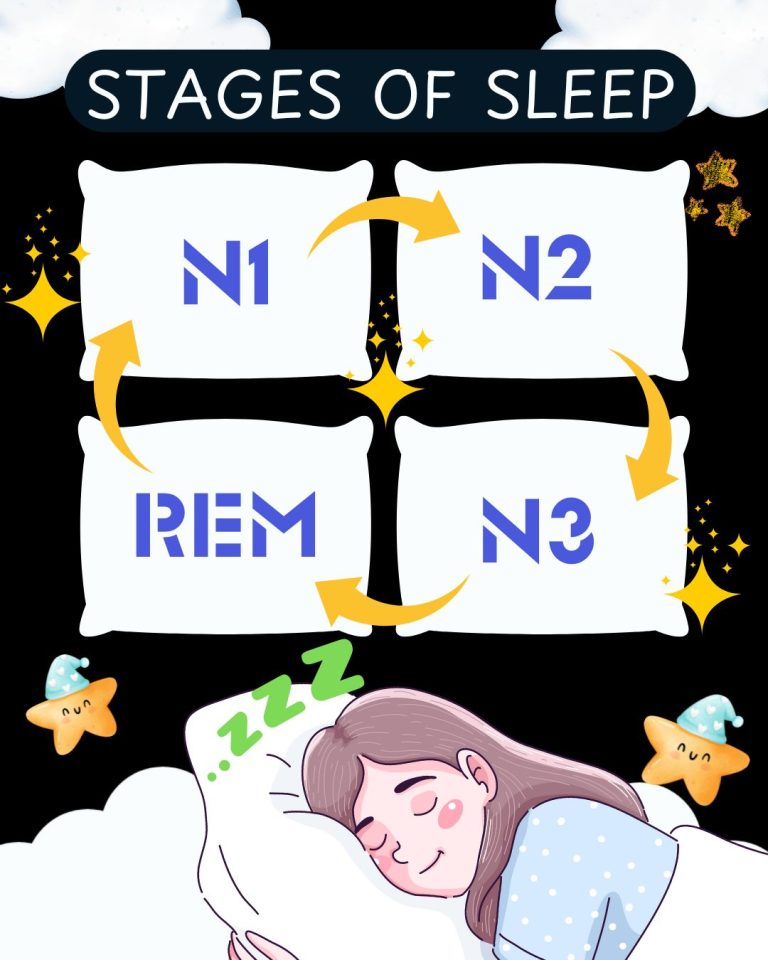
Having come this far, let’s delve a little deeper to understand how learning happens.
There are primarily two stages of sleep, REM (rapid eye-movement) and Non-REM or NREM sleep.
NREM consists of three stages- N1, N2, and N3.
Before we delve into these stages, let’s talk about the brain waves that are associated with them.
Brain Waves Trigger Brainwaves
Electrical activity in the brain gives rise to different kinds of waves. These waves surface during different stages of sleep at different times. Let’s take a peek at our Greek friends -alpha, beta, theta, delta, and gamma waves– and see what kind of role they play.
Alpha waves surface during an awake but relaxed state. If you’re taking a long walk or meditating, or just resting, you are in an alpha state. When you transition from a state of wakefulness to a state of sleep (as you are dropping off), slower brain waves called theta waves appear and slowly replace the alpha waves. They appear during N1 but may be present during N2 too.
Beta waves are small and very rapid and are present when you are alert, trying to focus, or engaged in doing something very intellectual. They increase in frequency and amplitude in N1 but decrease when you enter the deeper states of N2 and N3- that sounds logical, doesn’t it?
Delta waves usually occur in N3, and they are the slowest of brainwaves. That is why N3 is often called slow-wave sleep.
Gamma Waves are high-frequency brain waves that have the ability to transmit information very rapidly. They work in conjunction with alpha, delta, and theta waves.
The patterns of brain activity differ in each stage. Let’s briefly look at each stage.
N1 Stage
When you are just nodding off, your body is just beginning to relax, respiration and heartbeat slow down, muscles begin to lose their tension, and the core body temperature decreases. You’ve entered the N1 portals of sleep. So, when you sail into N1, you exist in between a state of wakefulness and sleep, a state of sleep so light that you can be easily awoken in case you drift off with your physics book in hand.
During this stage of relaxed sleep, which usually lasts for a few minutes at most, low-frequency alpha waves replace the rapid beta waves that were present during the waking state. And gradually, even slower theta waves begin to surface.
N2 Stage
If no one nudges you during the N1 stage, then you are capable of naturally transitioning into stage N2. Now, lower frequency theta waves increase in intensity and predominate. The body is in a state of deep relaxation — breathing and brain activity slow down even further, and eye movement comes to a full stop.
Although theta waves dominate during this stage, other higher frequency brain waves–sleep spindles– interrupt them. These are important for memory and learning. Sleep lasts longer during this stage, and you pass the ‘easy wake-up stage’ and begin to enter the land of ‘deep sleep’.
N3 Stage
In this stage, you sleep more deeply. Consequently, pulse and breathing rate plummet, and muscle tone decreases further. Getting into this deep state as early as possible and getting enough sleep during N3 is vital to feeling refreshed and rested. Now you know why if you’re rudely awoken from a deep sleep, you feel sleep-deprived, sluggish, and all confused.
Slow, strong delta waves characterize this stage and account for almost 25 percent of the total sleep. This stage lasts for about a little more than half an hour. The body makes use of this time to repair its armory and reinforce the immune system.
REM (Rapid Eye Movement) Stage
The body goes from the ‘very relaxed N3 state’ to a near-wakeful one. That’s why the brain activity and brain waves are on the uptick. Most of those vivid dreams you have happen in this stage, although dreaming can happen in other stages, too. Surprisingly, though, apart from the eyes and muscles that control respiration, the rest of the body is in a state of immobility. Thus, REM is sometimes called ‘paradoxical sleep’. Research indicates that REM sleep is vital to learning, as a lot of memory consolidation and brain development happen.
You can clearly see that sleep is not a ‘state of dormancy’ but a state that encompasses ‘highly complex stages of differentiated activity’.
During the night, your body goes through many sleep cycles.
Mechanisms of Sleep
The scenario becomes even more interesting and perhaps ‘more bewildering’ when you realize that there’s more to sleep than just waves and stages. Poof! Sleep seems to be pretty exhausting!
You may wonder why you feel sleepy at night and pretty wakeful during the day. Blame that on those two internal mechanisms that work in harmony to regulate your sleep-wake cycle- the Circadian Rhythm and the sleep-wake Homeostasis.
Circadian rhythms ensure that your body doesn’t need external alarms to sleep at night and get up in the morning. Cells in the retina process light, and your brain knows if it’s night or day.
Working in conjunction is the sleep-wake homeostasis. Homeostasis merely refers to creating a balance between the various systems of the body. For instance, it reminds you that your bedtime is nearing and you need to enter the Land of Nod. For every extra hour that you remain awake, this need for sleep only gets stronger and stronger. How often have you had to stave off those waves of sleep with gigantic cups of coffee!!
So long as your sleep-wake cycle and natural circadian rhythm are in sync, you have no problem. Disrupt this, and there is a mismatch between the actual clock and our internal biological clock. This makes it difficult to fall asleep. Jet lag is a classic example of how the body clock is out of sync with the natural clock. Many factors, such as stress, the surroundings where you sleep, oral medications, and exposure to light, influence the sleep-wake cycle.
A good night’s sleep!
Getting a good night’s sleep is important, so relax before you retire- listen to music or read a book, establish a specific bedtime routine, and switch off those bright lights before you enter the Land of Nod.
As Ralph Waldo Emerson once said:
“Finish each day before you begin the next, and interpose a solid wall of sleep between the two.”
0 comments on “The Land of Nod – where Brain Waves become Brainwaves”